
Sympathy Flowers in Dubai: What to Send, What to Write and How to Do It Respectfully

Few orders are harder to place than the one you make after someone has lost a person they love. You want to show up without saying the wrong thing, and in a city where colleagues, neighbours and friends come from every corner of the world, “the right thing” isn’t the same for everyone. This is the guide we’d want a friend to hand us: what sympathy flowers mean, when they’re welcome, when another gesture is kinder, and how to send them quietly and respectfully in Dubai.
Start With the Family, Not the Flowers
Before you think about what to send, think about who you’re sending it to. Customs around loss differ a great deal between communities, and flowers aren’t a universal part of them.
In Muslim families, funeral rites are usually carried out quickly and kept simple. The days that follow are centred on visiting the family, prayer and practical support rather than floral tributes. Gulf News describes a traditional condolence period of around three days, with friends and relatives calling in, often in separate gatherings for men and women, and expatriates expected to dress modestly when they visit (Gulf News has a clear overview). Flowers are not customary at the funeral itself. Some families would much rather receive a visit, a prayer, a meal, or a donation made in their loved one’s name.
That doesn’t mean flowers are wrong everywhere. Some Muslim families are glad to receive an arrangement at home in the days and weeks that follow, particularly from colleagues and friends of other backgrounds. Many Christian, Hindu, Buddhist and non-religious families see flowers as the natural way to say “we’re thinking of you.” The honest summary is that practice varies between families, communities and even generations, so it’s worth taking a moment to find out where your recipient sits.
If You’re Not Sure, Ask Someone Close
You don’t have to guess. A mutual friend, a colleague from the same community or a relative can usually tell you in one message whether flowers would be welcome. If you can’t find out, there are gestures that are almost never mistaken: calling or visiting to offer your condolences, sending a heartfelt written message, bringing or sending food, or making a charitable donation in the person’s name.
If you do decide flowers are right, keep the arrangement calm and modest. A family in mourning is often receiving visitors around the clock, and the last thing they need is something that demands attention or table space.
Choosing Sympathy Flowers: White, Soft and Unhurried
White is the colour most cultures associate with peace and respect, and it’s the safest starting point. Cream, soft green and the palest blush work well alongside it. What you’re avoiding is anything that reads as celebratory: vivid reds, bright oranges, shiny ribbons. If you want the meaning behind specific blooms, our guide to flower symbolism covers what different flowers and colours tend to say.
These are the arrangements from our collection that suit the moment best:
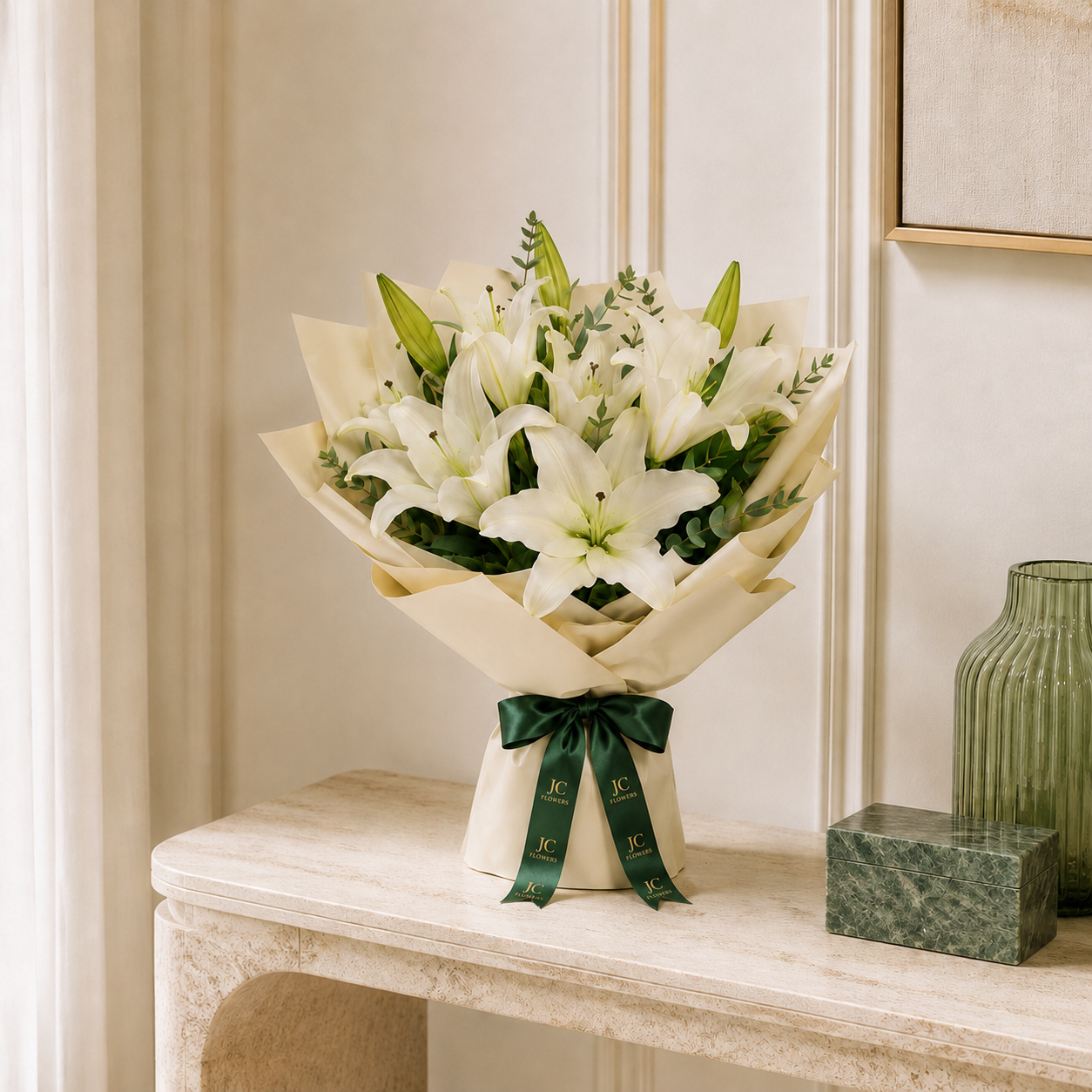
- White Lily Edit (from AED 349): a classic, pure white arrangement built around lilies. Lilies are beautifully fragrant, though, so keep that in mind for a small home already full of visitors.
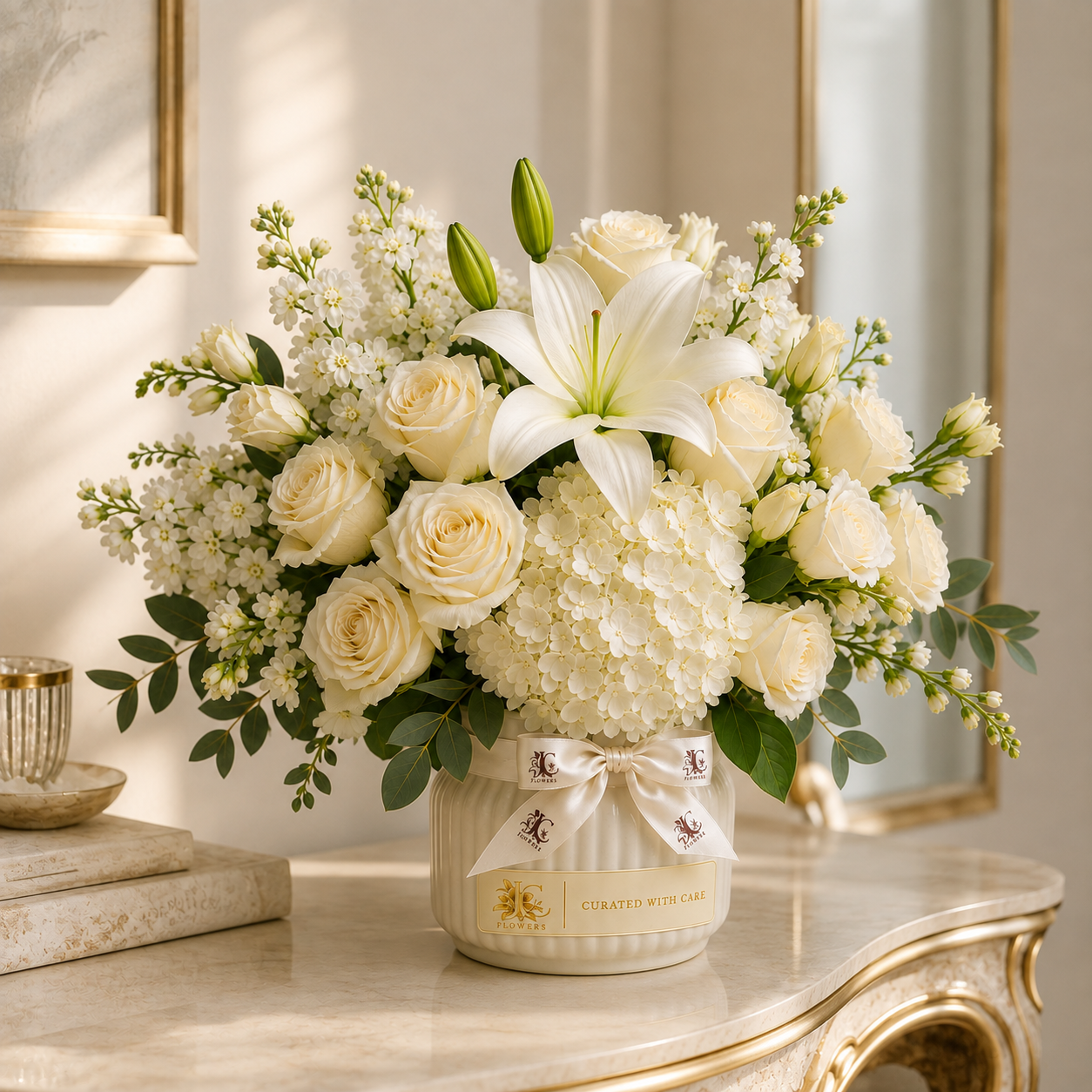
- Ivory Still Life (from AED 599): our most substantial white option, suited to a large family home or a shared office space.
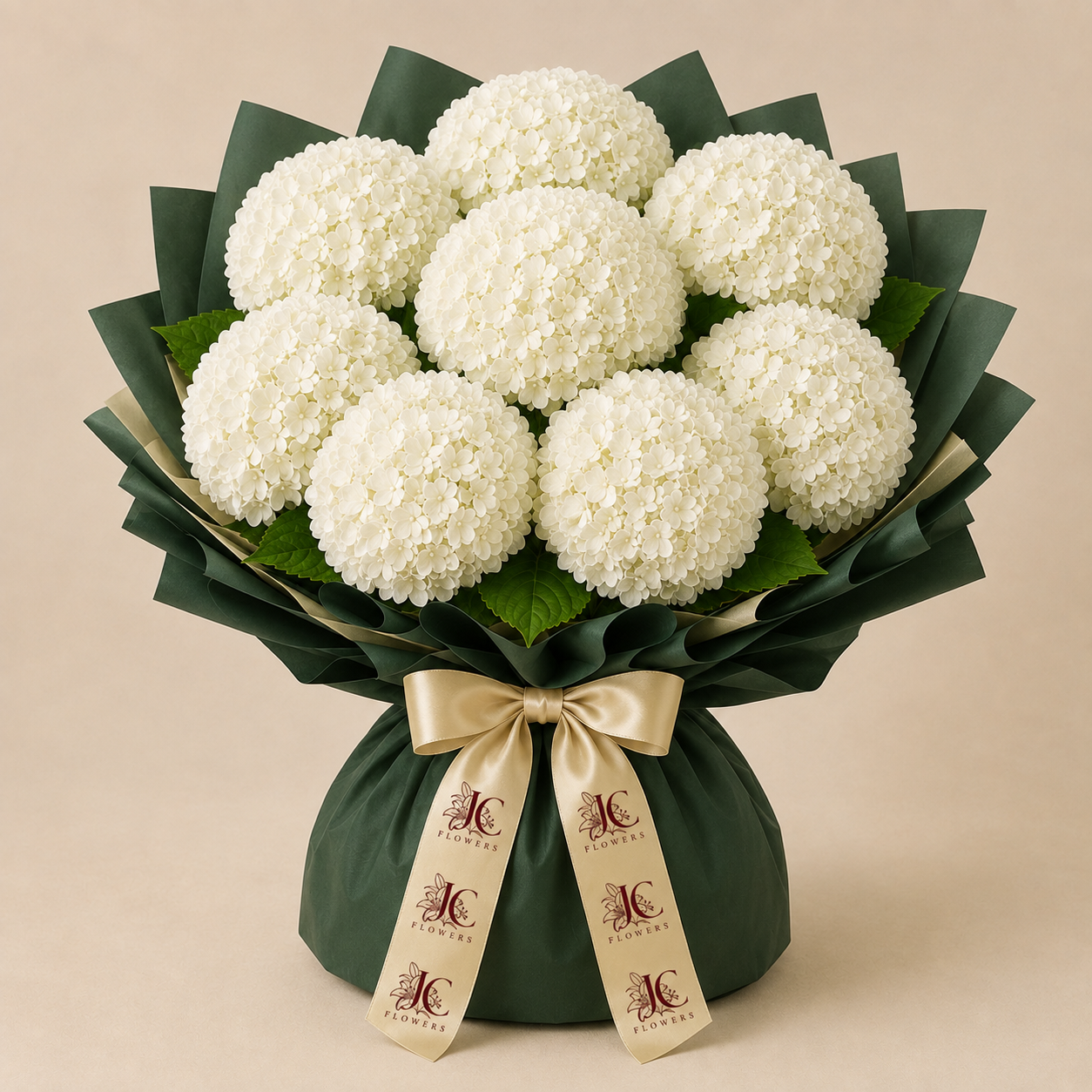
- Hydrangea Silhouette (from AED 399, available in white): full, soft and understated, with very little scent.
- Palette of the Day (from AED 399, available in a white palette): a gentle, mixed white arrangement when you’d rather not choose a single flower.
As a rule, choose smaller and simpler over larger and grander. An arrangement the family can place on a side table and keep for a week will always be appreciated more than one that needs rearranging the room.
What to Write on the Card
The card is often what the family remembers, and it’s where most people freeze. The good news is that short and sincere beats poetic every time. A few lines that work:
- “With deepest sympathy to you and your family.”
- “Thinking of you all. We’re here whenever you need us.”
- Something specific and personal, such as “Your father was so kind to everyone on our team. We’ll miss him.”
If you know the family is Muslim and it feels natural to you, a short dua is welcome, for example “Inna lillahi wa inna ilayhi raji’un,” or “May Allah grant him mercy and give your family patience.” If it doesn’t feel natural, plain English is perfectly fine; sincerity matters more than phrasing.
Avoid phrases that assume a belief the family may not share (“he’s in a better place”), avoid “at least” sentences, and resist the urge to offer advice. Put your own name on the card even if you’re a colleague or acquaintance; families often want to know who thought of them. And do double-check the spelling of names before you submit the order.
Timing and Delivery, Handled Quietly
There’s no deadline on kindness, but the first few days are when the gesture tends to matter most, because that’s when the family is at home receiving people. Send to the family’s home or, if you’re a colleague, the address you’ve been given. Arrangements sent to funeral venues or mosques are best avoided unless the family has asked for them, as those spaces have their own rules.
A few practical details specific to how we work:
- Same-day delivery is available for eligible arrangements within our delivery area for orders placed before 7:00 PM, subject to availability. Most eligible orders are prepared and delivered in roughly three hours.
- Delivery is AED 35 for orders below AED 299 and complimentary from AED 299.
- Our delivery area covers specific communities, listed on our Delivery & FAQs page. If the address is outside that list, or you’re thinking of a hospital, funeral home or venue, message us on WhatsApp before you order so we can tell you honestly what’s possible.
- Use the special-instructions field at checkout to mention that this is a sympathy delivery, and provide a reachable mobile number. If no one is available to receive it, we can leave it with reception, security or a neighbour with permission.
Sending Flowers From a Team or a Company
When someone at work loses a family member, a single arrangement “from all of us” is usually kinder than a scatter of individual ones. Agree on one card, keep the message simple, and ask HR or a manager for the right delivery address rather than searching for it yourself. If you regularly need to send flowers on behalf of a business, our corporate flowers service handles multiple deliveries and recurring requirements, and our guide to corporate flowers in Dubai explains how it works.
Remember Them After the First Week
Grief doesn’t end when the visitors stop coming. Some of the most meaningful gestures happen weeks later, when the house has gone quiet: a small arrangement with a note that says “still thinking of you,” or a message on a birthday or anniversary that says the person hasn’t been forgotten. Many communities also observe set periods of mourning over the weeks that follow, so a later gesture rarely arrives at the wrong time.
If you’re supporting someone through illness rather than loss, our guide to get well soon flowers in Dubai covers what to send and how to check hospital rules first.
Frequently Asked Questions
Is it appropriate to send flowers to a Muslim family in Dubai?
It depends on the family. Flowers are not customary at a Muslim funeral itself, and some families prefer a visit, prayers or a donation. Others are happy to receive an arrangement at home afterwards. If you’re unsure, ask someone close to the family or choose a gesture such as a visit or heartfelt message instead.
What are the best flowers to send for sympathy?
White and cream flowers such as lilies, roses and hydrangeas are the most widely appropriate, with soft greenery alongside. Avoid bright, celebratory colours and keep the arrangement modest in size.
Should I send flowers to the funeral or to the family’s home?
The family’s home is usually the better choice, since that’s where visitors gather in the days that follow. Funeral venues have their own rules, so check with the family first.
How soon should I send sympathy flowers?
The first few days are ideal, but there is no wrong time. A gesture that arrives a week or a month later is often especially appreciated.
What should I write on a sympathy card?
Keep it short and sincere: an expression of sympathy, a line about the person if you knew them, and your name. Avoid clichés and assumptions about belief.
Can I send sympathy flowers the same day?
Yes, for eligible arrangements within our delivery area when the order is placed before 7:00 PM, subject to availability. Contact us first if the address is not on our published delivery list.
If you’d like help choosing something appropriate, get in touch and we’ll guide you, or browse our arrangements by occasion.